
Medusa and Perseus: The Myth, the Gorgons and the Symbol
Perseus and Medusa are the hero and the monster of one of the oldest stories in Greek mythology: a Gorgon whose gaze turned people to stone, and the young man sent to bring back her head. He managed it by refusing to look at her, which remains sound advice for most monsters.
Here is who Medusa was, how Perseus killed her, what happened to her head, and why the Greeks put that head on shields, temples and coins. The coins of today are in our Greek mythology coins collection.
TL;DR: key takeaways
- Medusa was one of three Gorgons and the only mortal one; her sisters Stheno and Euryale were immortal.
- Perseus, son of Zeus and Danaë, killed her by watching her reflection in a polished shield.
- Pegasus and the giant Chrysaor sprang from her neck when she died.
- Athena placed Medusa's head on her aegis, and the Gorgon's head, the gorgoneion, became a symbol of protection.
- The gorgoneion appeared on Greek coins as early as the 6th century BC.
Who Was Medusa?
In Greek mythology Medusa was one of the three Gorgon sisters, daughters of the sea deities Phorcys and Ceto. Her sisters, Stheno and Euryale, were immortal; Medusa was the only mortal Gorgon, which is why she alone could be killed. Hesiod already tells it this way in the Theogony.
Ancient writers gave the Gorgons snakes for hair, wings and a gaze that turned anyone who met it to stone. By the 5th century BC Pindar, Aeschylus and Pherecydes all know about the petrifying gaze. According to Herodotus and Pausanias, the Gorgons lived far to the west, in Libya.
Medusa was never a goddess. Her name probably comes from the Greek verb medein, "to guard" or "to protect," a fitting name for the face that later guarded Greek armor and doorways.
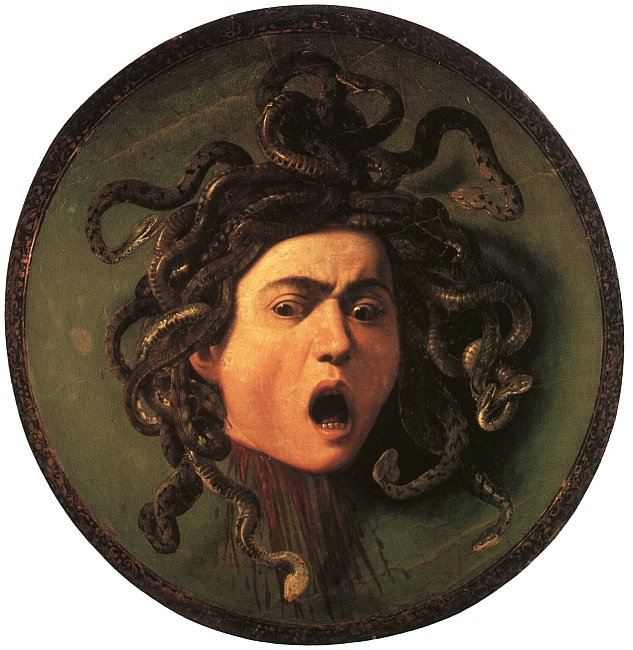
Caravaggio, "Medusa," about 1597, painted on a ceremonial shield. Uffizi Gallery, Florence.
Was Medusa a Monster or a Victim?
Both, depending on who tells Medusa's story. The Medusa myth changed a great deal between the first Greek poets and Roman literature.
The older Greek myth
In the oldest Greek myths the Gorgons are monsters from birth, and Medusa is simply the one Gorgon who can die. Pindar, however, calls her "fair-cheeked," so even early poets imagined a hideous monster with a beautiful face.
Ovid's version: a beautiful woman punished
The most widely known version comes from the Roman poet Ovid, whose Metamorphoses appeared in the early 1st century AD. In Ovid, Medusa is the most beautiful woman of her time, courted by many suitors, and her beautiful hair is her greatest pride.
Neptune, the Roman Poseidon, rapes her in the temple of Minerva, the Roman Athena. The goddess punishes not Poseidon but the woman he attacked, and turns her hair into snakes. That is how Ovid's Athena transformed Medusa from a mortal woman into the Gorgon.
Was Medusa a priestess of Athena?
Many modern retellings make the beautiful maiden a priestess of Athena who broke her vows. Ovid doesn't say that: in his telling the assault simply happens in Athena's temple. The priestess detail belongs to later retellings, not to the ancient sources.
A symbol of female rage
Read today, Ovid's story of sexual assault looks like victim blaming: a woman who was raped is punished, and the victim becomes the monster of the myth while her attacker goes free. That is why feminists have adopted Medusa as a symbol of female power and female rage, and why several recent novels retell the myth from her side.
In 2008 the artist Luciano Garbati reversed Cellini's famous statue and sculpted Medusa holding the head of Perseus, a feminist version of the story in bronze. In October 2020 the bronze was put up in Collect Pond Park in Manhattan, facing the New York County Criminal Court.
Who Was Perseus?
Perseus was the son of Zeus and Danaë. Danaë's father, King Acrisius of Argos, had been told that his grandson would kill him, so he locked his daughter in a bronze chamber, a bronze tower in some versions. The king of the gods reached her as a shower of gold, and Perseus was born.
Acrisius shut mother and child in a wooden chest and threw it into the sea. The chest washed up on the island of Seriphos, where Perseus grew up under the eye of King Polydectes.
The Myth of Perseus and Medusa
Polydectes wanted to marry Danaë and to be rid of her grown son. He asked Perseus for a gift no one could bring: the head of Medusa. Of all the Greek myths about heroes, few start with a task this hopeless. Perseus accepted, and the gods made sure he had a chance to slay Medusa.
The gifts of the gods
No one could defeat Medusa by looking at her, so the gods equipped Perseus for a fight without eye contact.
- Athena gave him a polished bronze shield, so he could watch Medusa in its reflection.
- Hermes gave him a curved sword, the harpe.
- The nymphs gave him winged sandals, a bag for the head (the kibisis) and the helmet of Hades, which made the wearer invisible.
The way to the Gorgons was known only to the Graeae, three old sisters who shared a single eye and a single tooth. Perseus took the eye and gave it back only once they told him the way.
The death of Medusa
Perseus found the Gorgons asleep. He flew down to Medusa, looked only at her reflection in the polished bronze and beheaded her with one stroke. He put the severed head into the bag and escaped her immortal sisters under the helmet of invisibility.
Pegasus and Chrysaor
From Medusa's neck sprang the two children she had conceived with Poseidon: the winged horse Pegasus and the giant Chrysaor. The winged horse was later tamed by the hero Bellerophon.
Perseus and Andromeda
On the way, Ovid adds, the Titan Atlas refused Perseus hospitality, and Perseus turned him to stone; the giant became the Atlas Mountains.
Further on, Perseus found a princess chained to a rock as an offering to a sea monster, the price of her mother Cassiopeia's boasting. He killed the monster and married Andromeda. When her former fiancé Phineus attacked at the wedding, Perseus turned him and his men to stone with the head.
Back on Seriphos he did the same to Polydectes and his court, then gave Medusa's head to Athena. The prophecy still came true: years later, at an athletic contest, a discus thrown by Perseus struck and killed Acrisius.
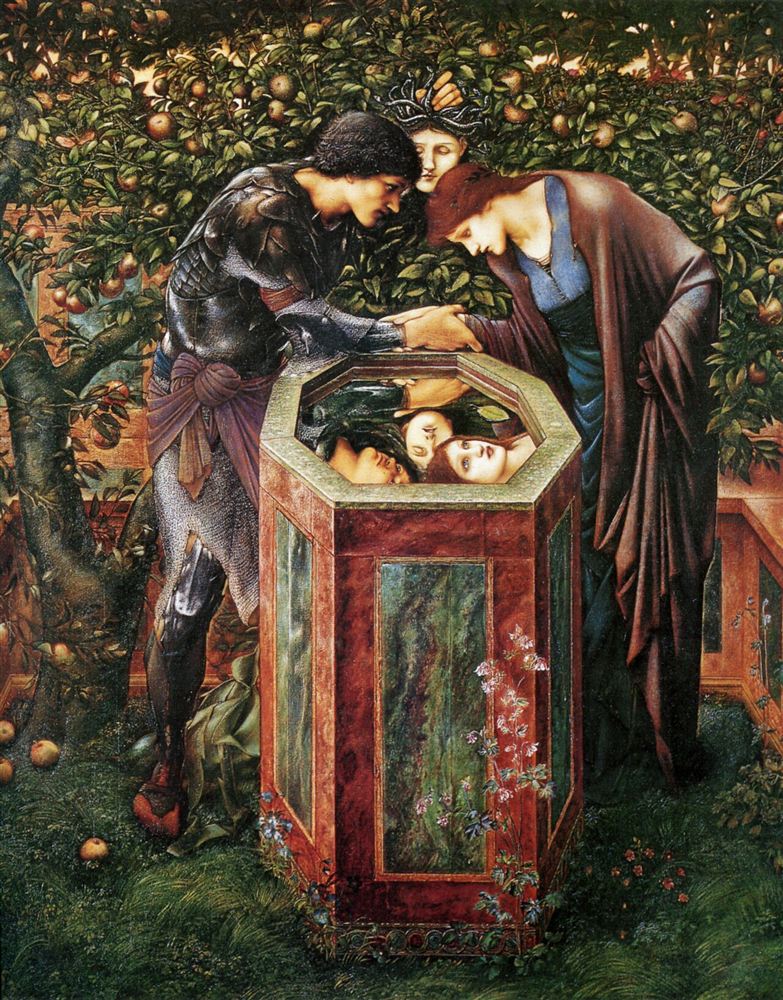
Edward Burne-Jones, "The Baleful Head," from his Perseus series: Perseus shows Andromeda the head of Medusa reflected in a well.
The cast of the story ended up in the night sky. Perseus, Andromeda, Cassiopeia, Cepheus and Pegasus are all constellations, and Perseus is also the great-grandfather of Heracles: his son Electryon was the father of Alcmene, Heracles' mother.
What Does the Head of Medusa Symbolize?
Protection. In the myth, Athena set it on her aegis, her goatskin cloak or shield, where it terrified her enemies. One tradition says it was buried in the agora of Athens instead.
Across ancient Greece, artists painted and carved the gorgoneion, on shields, armor, vases and temples to ward off evil. In a well-known piece of Greek art, a huge Gorgon fills the 6th-century BC pediment of the Temple of Artemis on Corfu, now in the island's Archaeological Museum.
The protective symbol survived antiquity: Medusa's head still sits at the center of the flag of Sicily, surrounded by three legs and ears of wheat.
The gorgoneion on ancient coins
Coins carried it too. The city of Neapolis in Macedon struck silver staters with a facing Gorgon's head on the obverse from about 525 to 450 BC; one is in the Harvard Art Museums. More about the coins of that world is in our guide to ancient Greek coins.
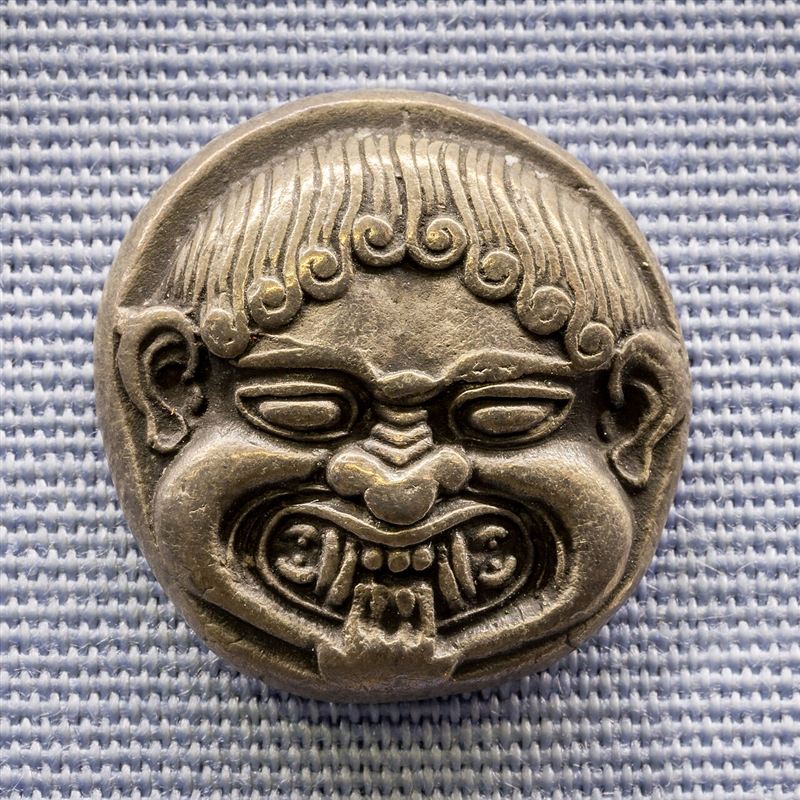
Silver stater of Neapolis in Macedon with a facing gorgoneion, about 480 BC. Staatliche Münzsammlung München. Photo: ArchaiOptix, CC BY-SA 4.0.
Medusa in art and culture
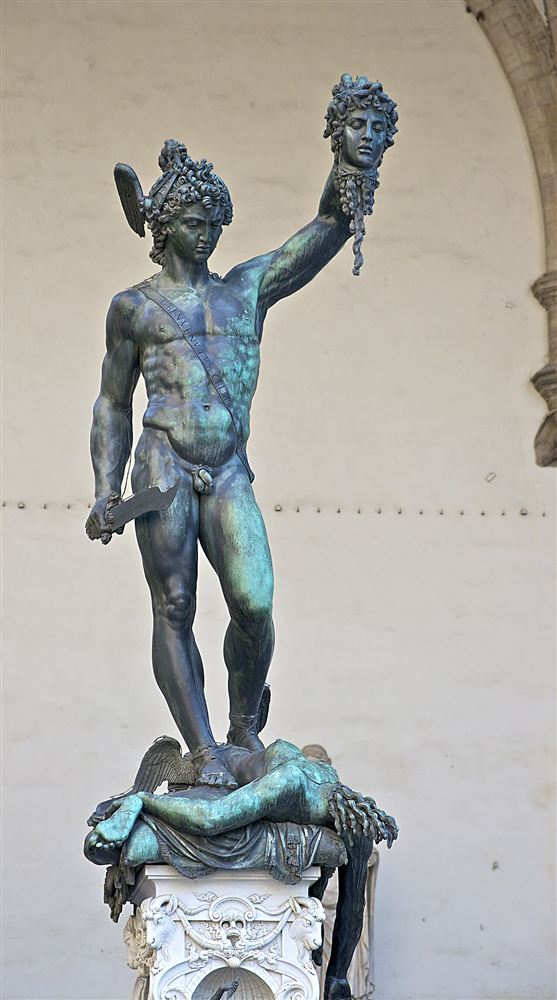
Benvenuto Cellini, "Perseus with the Head of Medusa," 1545–1554. Loggia dei Lanzi, Florence.
Few myths have given art as many images as the story of Perseus and Medusa, from vase painting to modern literature.
- Benvenuto Cellini's bronze "Perseus with the Head of Medusa" (1545–1554) stands in the Loggia dei Lanzi in Florence.
- Caravaggio painted his "Medusa" around 1597 on a ceremonial shield, now in the Uffizi.
- The Versace logo shows the head of Medusa.
- A Medusa tattoo is most often read as protection and survival, a direct echo of the gorgoneion.
The ancient sources themselves, from the earliest poets to Ovid, are collected on Theoi Greek Mythology, an online library of classical mythology.
Perseus and Medusa on Coins
A story of courage, betrayal and fate, the myth has been a favorite of coin designers since Neapolis, and it still is.
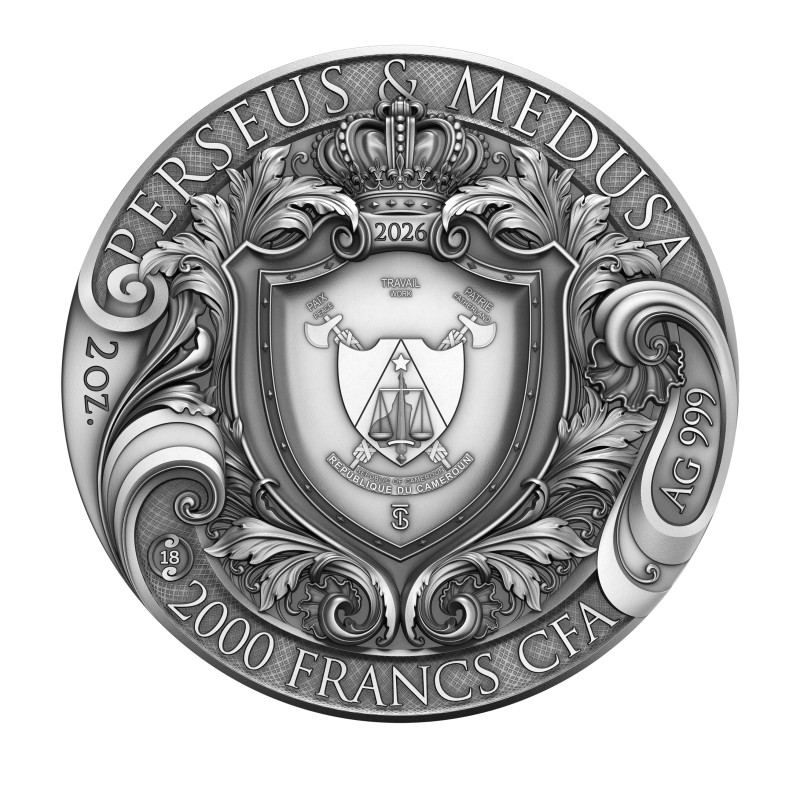
The newest example is a 2 oz high-relief coin from Cameroon by T&S Coin. Perseus stands in gilded armor with a winged helmet and raises Medusa's head with colored snakes, while a warrior turned to stone stands behind him. It's available for pre-order.
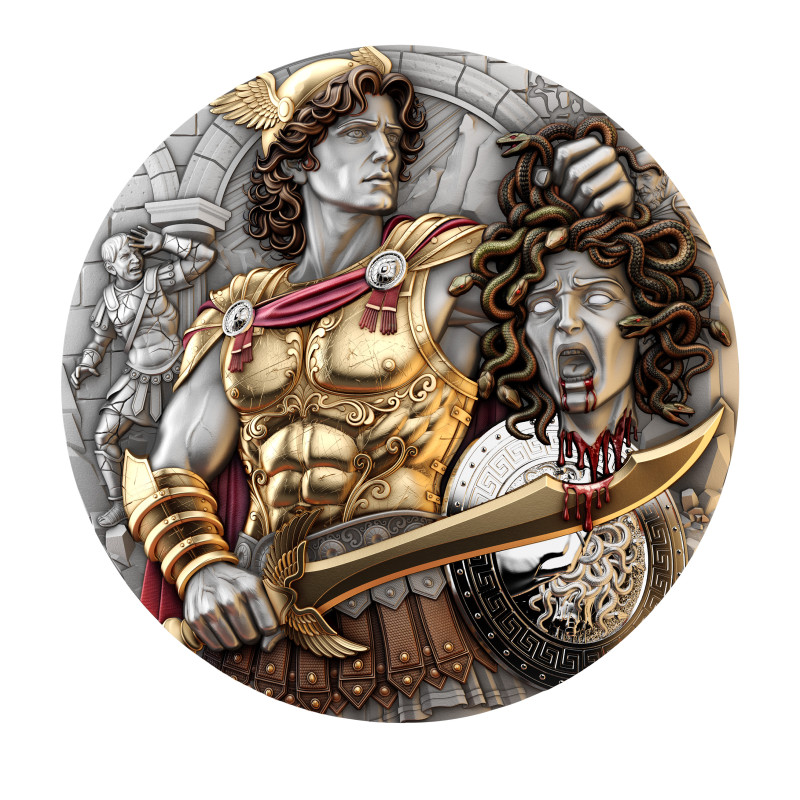
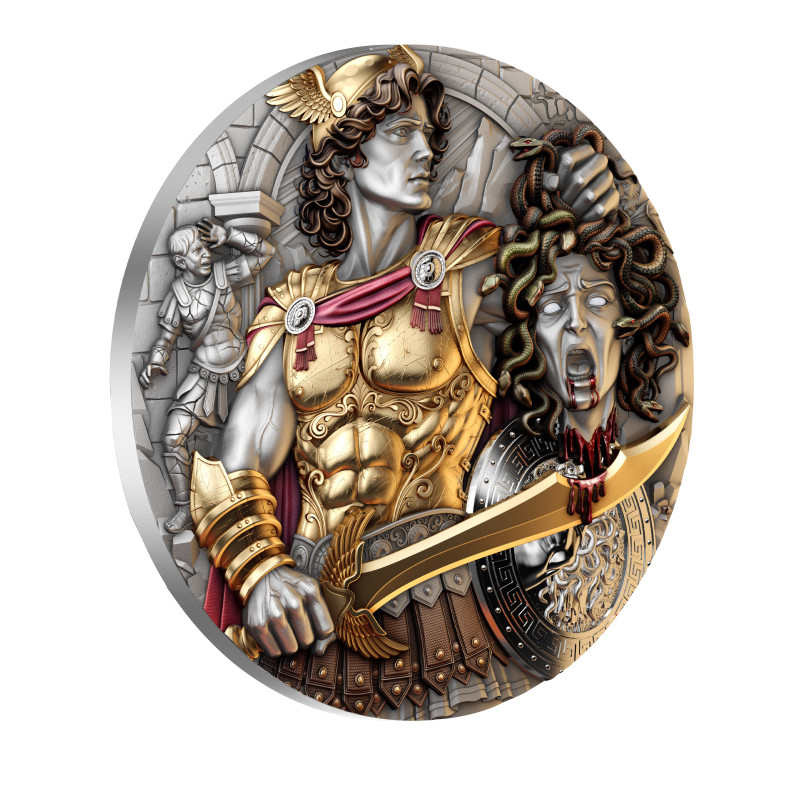
Perseus raising the head of Medusa
Perseus & Medusa
2 oz silver coin · Cameroon 2026 · T&S Coin
Available for pre-order – allow for the release date.
Pre-order this coin →★ Limited to 500 pieces worldwide
Earlier issues are sold out with us, but their pages show the designs: Medusa, Greek Mythology 2 oz (sold out), Medusa Diamonds 3 oz (sold out), Perseus, Demigods 2 oz (sold out) and, for Medusa's winged son, Pegasus 1 oz (sold out).
Perseus's great-grandson: Heracles
Athena helped Perseus, and she helped Heracles too. For his sixth labor she gave him bronze rattles to scare the man-eating Stymphalian birds into the air. The Mint of Poland strikes the Twelve Labours of Hercules as a series of 2 oz coins for Niue, 500 of each.

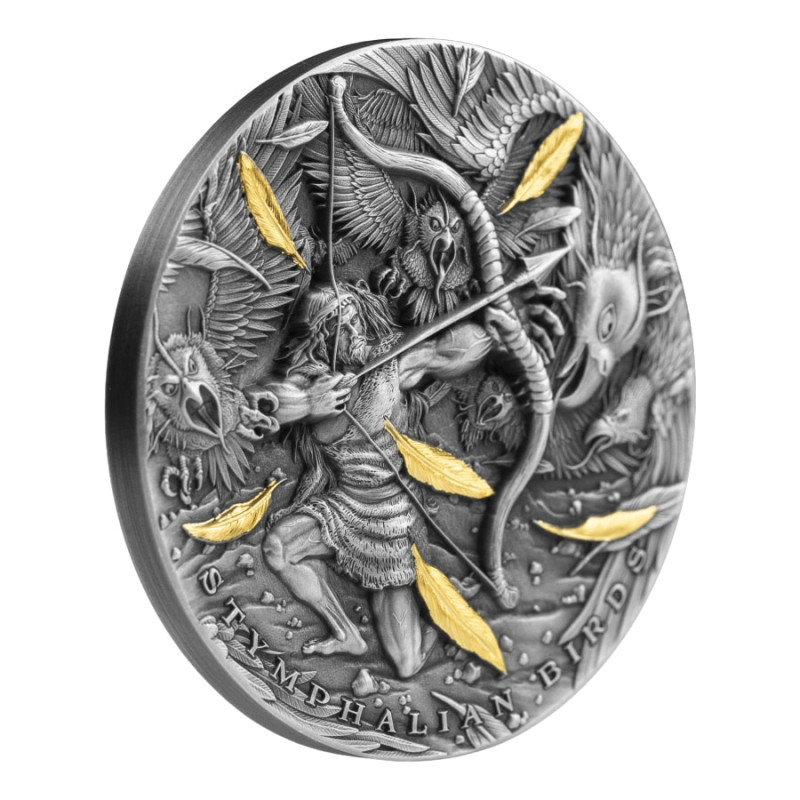
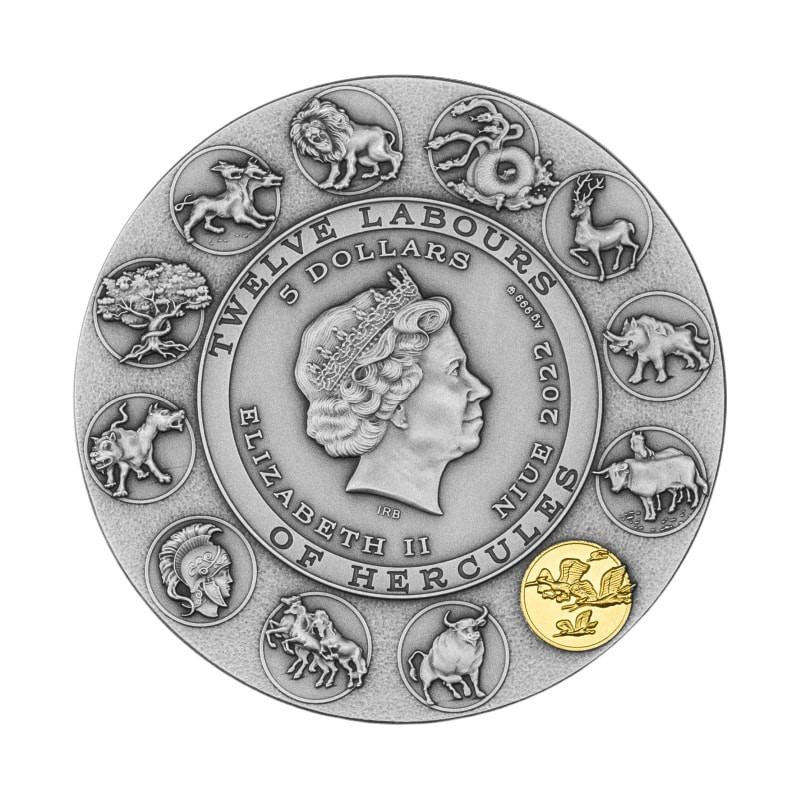
Athena helped Heracles too
Stymphalian Birds – Twelve Labours of Hercules
2 oz silver coin · Niue 2022 · Mint of Poland
★ Limited to 500 pieces worldwide
The Hydra, whose heads grew back two for one, is the labor that matches Medusa for monstrosity. This 10 oz coin from Samoa turns the fight into a 3D sculpture with a black antique finish, in a mintage of 199. It's available for pre-order.
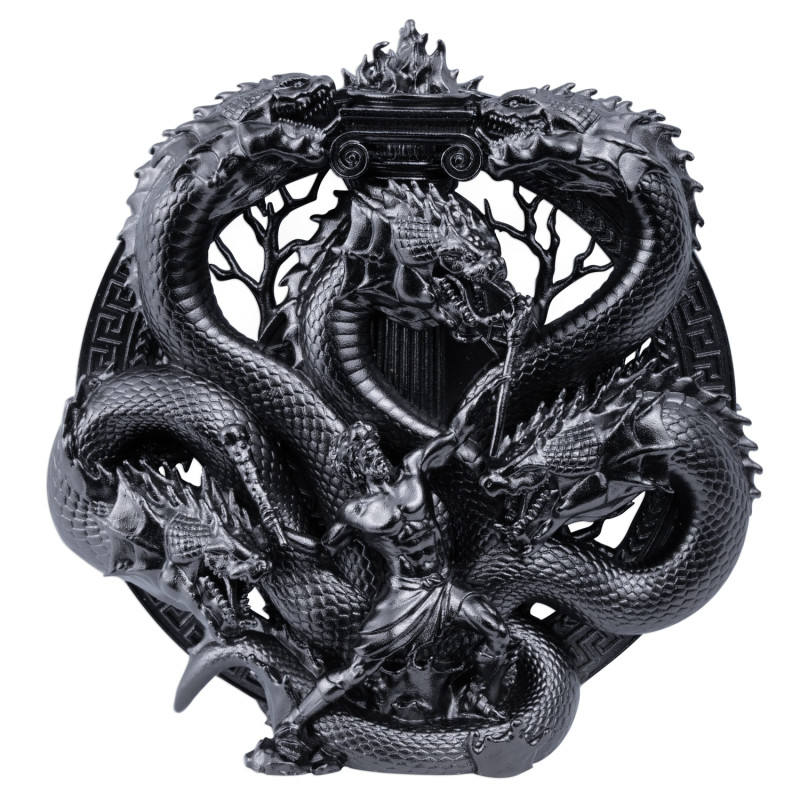
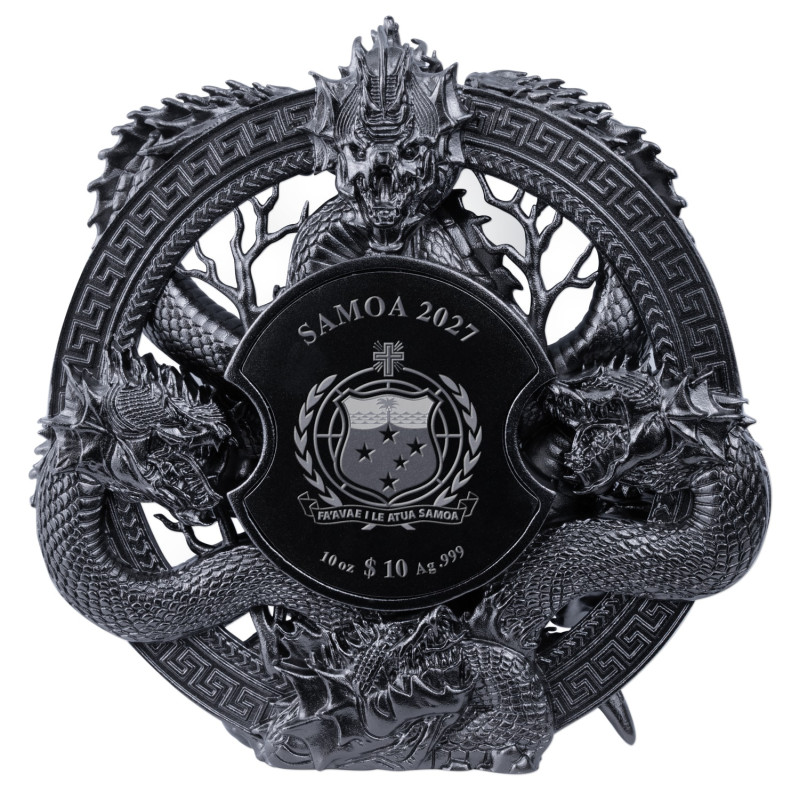
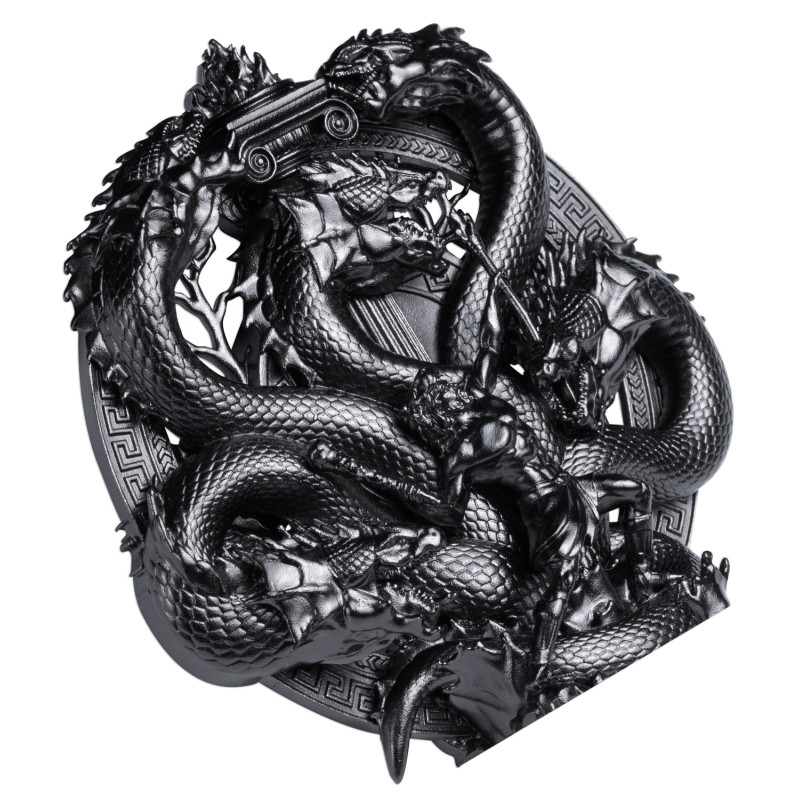
Ten ounces as a 3D sculpture
Hercules vs. Hydra 3D
10 oz silver coin · Samoa 2027 · MDM
Available for pre-order – allow for the release date.
Pre-order this coin →★ Limited to 199 pieces worldwide
More gods and heroes are in our article on Greek gods, their symbols and key myths.
About Magikos Coins
Magikos Coins is a collector coin shop from Kraków, Poland. Since 2009 we have been selling limited-mintage silver and gold coins from mints around the world, including new mythology issues every season. We are an authorized distributor of the Mint of Poland, Germania Mint, Power Coin, MDM, AllCollect and MINT XXI.
- Trusted seller: 100% positive feedback on eBay, Allegro and Catawiki, and an eBay feedback score of over 2,500 since 2009. Read our reviews on Trustpilot.
- Worldwide shipping: we ship to the US and around the world with Global Express and FedEx, and every parcel is carefully packed.
- Easy payment: pay in US dollars with PayPal or a card. See all payment methods.
- Direct contact: questions about a coin go straight to us, by e-mail, WhatsApp, Facebook or Instagram.
Learn more about us.
Just added
New in the Magikos Coins shop


FAQ: Perseus and Medusa
Who killed Medusa?
Perseus, son of Zeus and Danaë. He beheaded her while watching her reflection in Athena's polished shield.
Was Medusa a goddess?
No. She was a Gorgon, a daughter of the sea deities Phorcys and Ceto. Her name probably means "guardian" or "protector."
Why did Medusa turn people to stone?
Her gaze had that power, like the gaze of all the Gorgons. In Ovid's version it was part of Athena's punishment, together with the snakes in her hair.
How many Gorgons were there?
Three: Stheno, Euryale and Medusa. Only Medusa could die.
What happened to Medusa's head?
Perseus used it to turn his enemies to stone and then gave it to Athena, who placed it on her aegis.
Was Medusa a victim?
In Ovid's version, yes: Poseidon raped her in Athena's temple, and Athena punished Medusa instead of him. The older Greek myth describes her as a monster from birth.
Where is the statue of Perseus with the head of Medusa?
Benvenuto Cellini's bronze stands in the Loggia dei Lanzi on the Piazza della Signoria in Florence.
What does a Medusa tattoo mean?
It is most often read as protection, strength and survival, echoing the ancient gorgoneion that was meant to ward off evil.